
Process mapping
Find where time, context or consistency is being lost.
AI automation
I look for repetitive work, bottlenecks and badly connected flows and turn them into systems that are useful and maintainable.
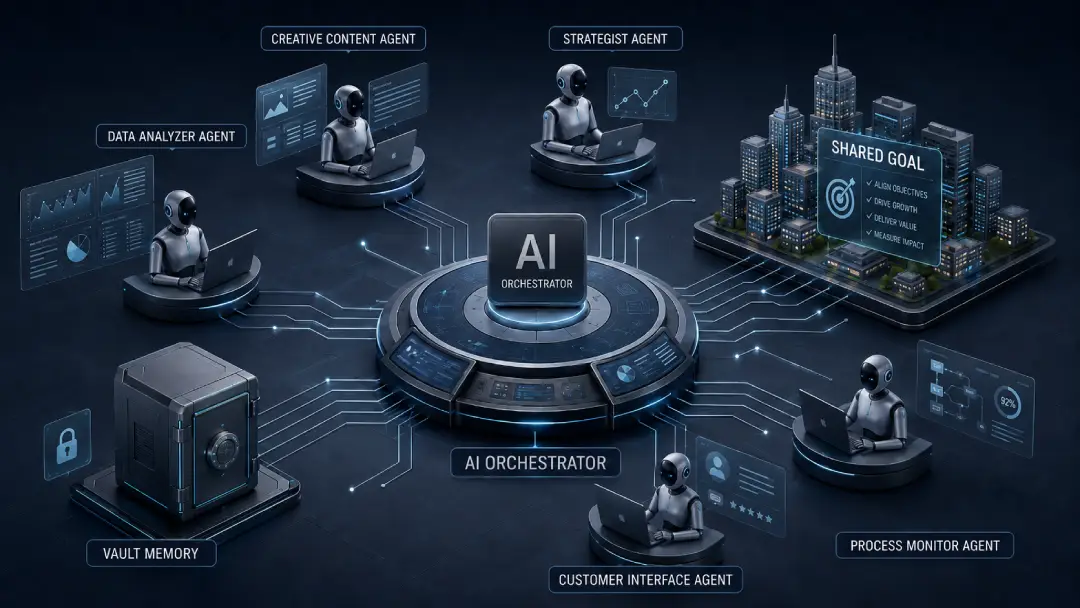
Approach
Automation matters when it removes friction, improves output quality and keeps control points visible.
Find where time, context or consistency is being lost.
From agent and tool orchestration to exact result validation.
Documentation, handoff and rules the team can keep working with.
What changes
The team gets time back for analysis, creativity and decisions.
Reporting, documentation or drafts follow a reliable structure.
It becomes clear what goes in, what comes out and where to intervene when something fails.
If you already have a repetitive process, we can turn it into a measurable prototype before scaling it.
Use cases
I work with existing processes where repetition, context loss or control requirements are already visible.
Collect, normalize and explain recurring data for marketing, sales or operations teams.
Systems to summarize sources, extract learnings and keep internal documentation up to date.
Workflows for briefs, drafts, editorial checks and consistent deliverables.
Automation for admin tasks, handoffs, alerts and recurring materials.
Checks to detect errors, duplicates, deviations or incomplete information before it is used.
Clear structures so strategy, content, paid media, SEO and operations work from the same context.
Deliverables
The scope can stay small and pragmatic or grow if the workflow deserves it.
Diagnosis of steps, friction and dependencies.
A working version to validate value before scaling.
Instructions, checks and editorial or operational guardrails.
Documentation to operate, review and evolve the system.
Process
I start with concrete use cases and real friction. The automation comes after that.
01
Pick a workflow with repetition, cost or accumulated error.
02
Prototype the system and review quality, controls and limits.
03
Leave it ready for internal use or further iteration.
Technical stack
I combine models, frameworks and automation tools according to the level of control, integration and scalability each use case needs.
I design agents with instructions, tools, limited memory and clear stopping criteria.
I connect steps, approvals, APIs and automations so the flow is predictable and auditable.
I use retrieval when the system needs to work with documentation, history or internal knowledge.
I define logs, metrics, output tests and reviews to detect degradation or recurring errors.
I consider permissions, security, maintenance and vendor dependency before putting a workflow into production.
Common questions
Not always. Many improvements come from connecting existing processes properly before adding more tools.
Yes. Reporting, research, documentation, briefs, content and admin tasks are all strong candidates.
It depends on integrations and data access, but I usually start with a small scope that validates usefulness before investing more.
Limits are defined from the start: what data goes in, where it is processed, who reviews the output and which parts should not be automated.
When the process is not clear yet, the volume does not justify the effort or the risk of a wrong output is higher than the expected saving.